I open my eyes. Instinctively, I reach for my phone, horrified that I must have overslept. At the same time, the phone rings. I pick it up and hear: „you ordered a 2 am wake up call.”
Fifteen minutes later, I’m in the saddle and heading for the northern exit out of town. At the city border I am stopped by the police. They say something in Spanish, and I guess they mean their municipality’s COVID curfew. Fortunately, Carlos gave us an official Spanish-speaking certificate at the start, that we are in the race and should be treated as a so-called transit riders. Therefore, I did not care about this control at all. In the end, the policemen were satisfied with my assurance that I did not understand anything in Spanish and that it would be best for them to explain all of that to me in English. So they waved at me in sign language and clearly showed that I can go wherever I want.
It was fantastic to continue to ride that night. I was riding very well and was keeping 30 km per hour without any problems. The route along the lagoons of El Grado is a true cycling pearl. Gentle and winding climbs and long repetitive descents introduced me to my favourite rhythm, continuous, incessant, repetitive and stable. I was thinking very intensely about the next checkpoint, Ordesa National Park and the famous HU631 road. At sunrise, I checked the Follow My Challange. I could see that Urlich has already started and is a few hours ahead of me, and Justinas is already following me. I must have overtaken him sometime during the night.
At 7 am I arrived to Ainsa, the last place where you could stock up on food before the section in the Pyrenees. I stoped at the bakery, dreaming about the sweet bread I will consume in a moment. Of course, I also order a strong latte, three bottles of cocoa and a few croissants for the road. After a break for a few minutes, I move up.
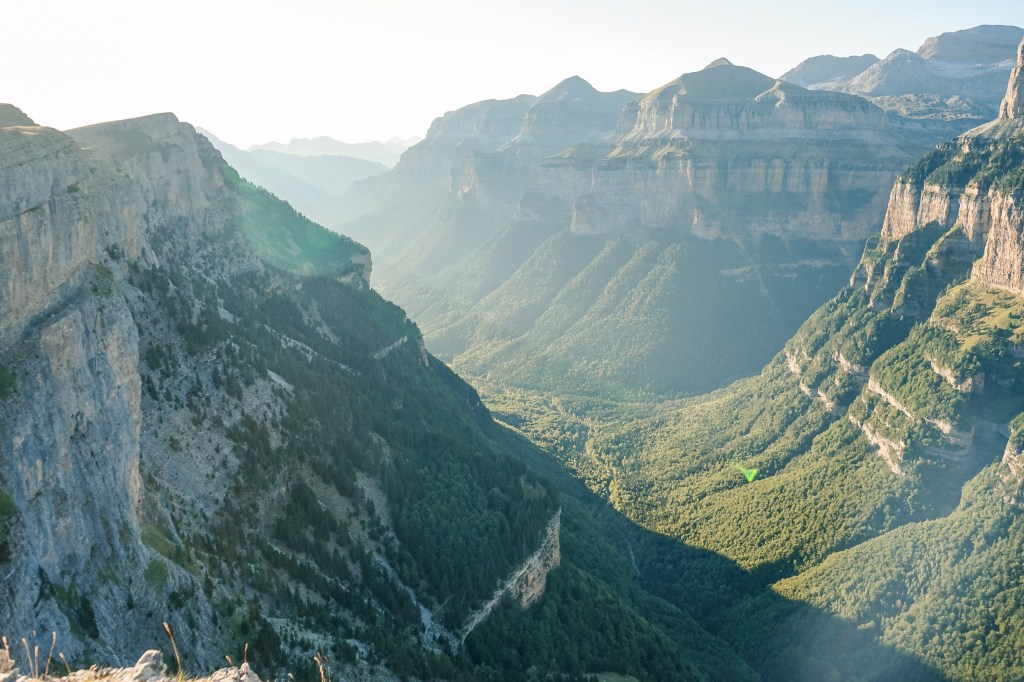
HU631 turns out to be fantastic. Maybe the surface is not the best in the world, but the canyon it leads through, makes a really big impression on me. In addition, the high rocks around it effectively block the sun’s rays and the temperature is just perfect. After a short while, I go to an altitude of well over 1000 m and around the bend, a car appears with Carlos and Pablo in the middle (organizers and media), who without a moment’s thought point their camera lenses at me.
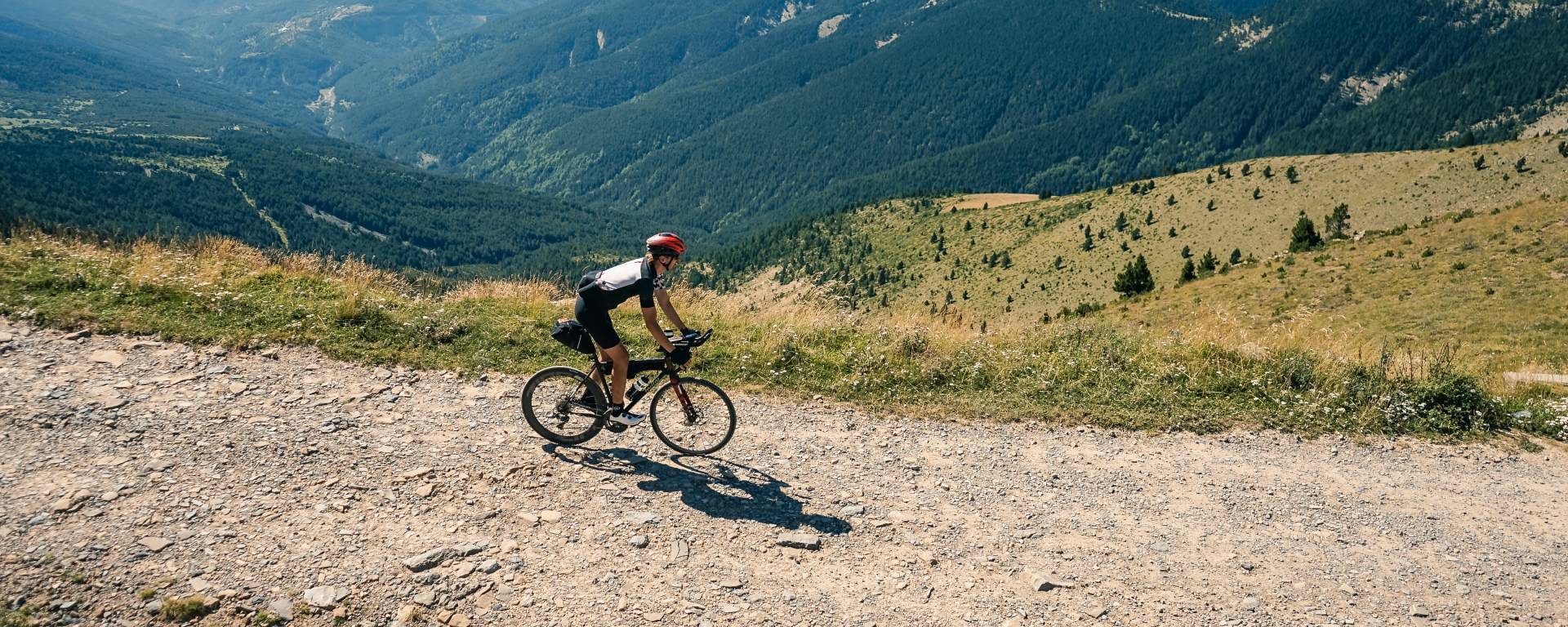
I turn right from this wonderful road for the last 12 kilometres climb, which leads along a beautifully maintained gravel road. The climb is not steep, it is simple and very pleasant. It’s just long. The media car passes me back and forth every few kilometres. The sun is no longer bothersome because at an altitude of nearly 2,000 meters. Besides, it’s still a lot before noon so the temperature hasn’t started its crazy rise yet.
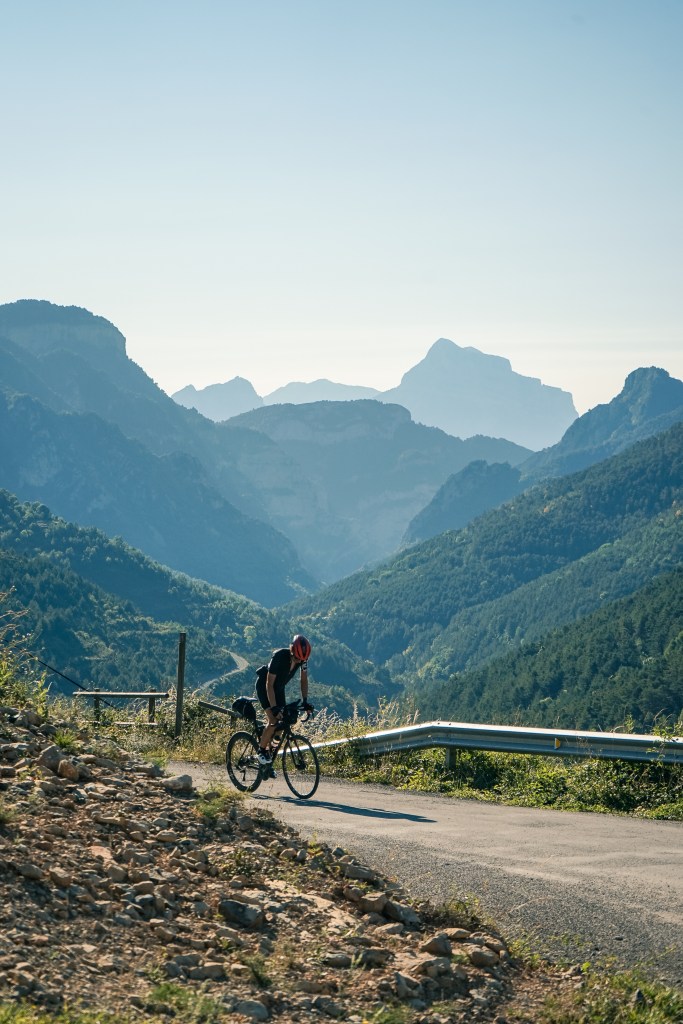
At the top, I stop for a few words with the team. The views are simply amazing and Carlos only smiles when I inform him of my plans to take a shortcut off this wonderful mountain pass, following a 16km western gravel stretch. Honestly, when I reached the top, I figured the quickest option would most likely be to go down the same road I climbed up and continue west on HU631. However, my cheeky nature whispered in my ear that it is worth taking the risk and checking what this western, undiscovered by any race rider yet gravel road looks like.
What can I say, it was certainly not fast, and there is a saying: we have time so we take the shortcut. A few hundred meters of hike a bike at the top, then a better section for a few kilometers rather flat, with large stones, admittedly, but somehow I managed to roll the bike while standing on pedals.
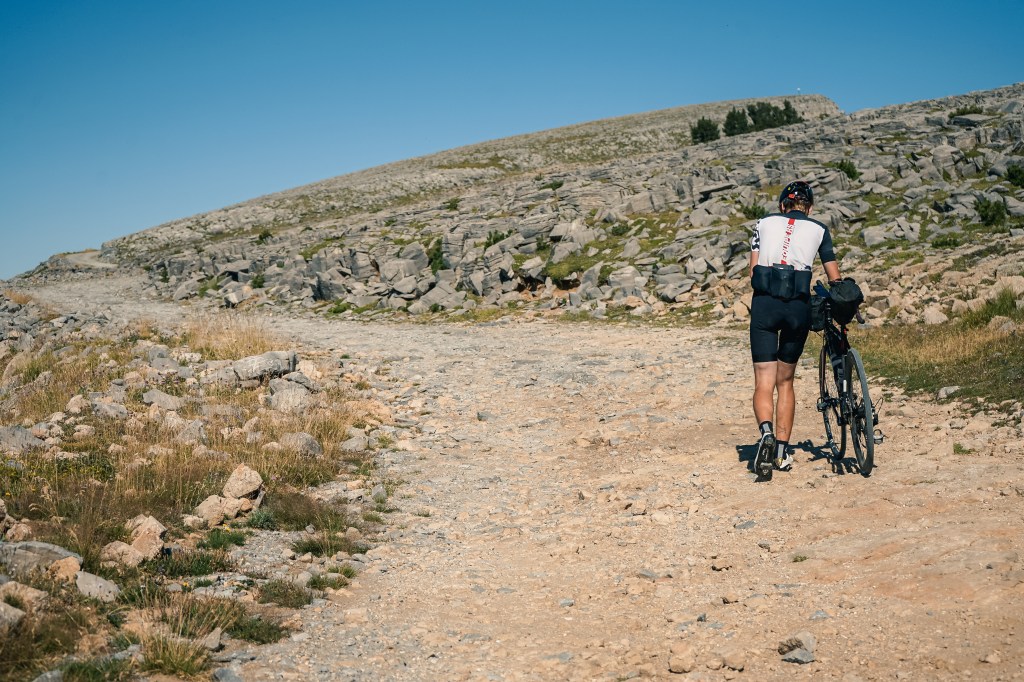
The descent itself was long, very uneven, and painfull for the wrists and arms. Over an hour of holding the brakes in various gripping configurations. The last kilometers became very steep, and hairpins caused the bike to slide along the broken road. At one point, I instinctively unclipped one leg. Everything would be fine if it wasn’t for the fact that I was wearing road shoes and while trying to clip back, my foot slipped on the pedal and I crashed on the stones. Fortunately, no major damage, although my fork and my right hand were severely scratched with these stones. Hoping it was just external scratches, I quickly stood up and continued this extremely adventurous descent.
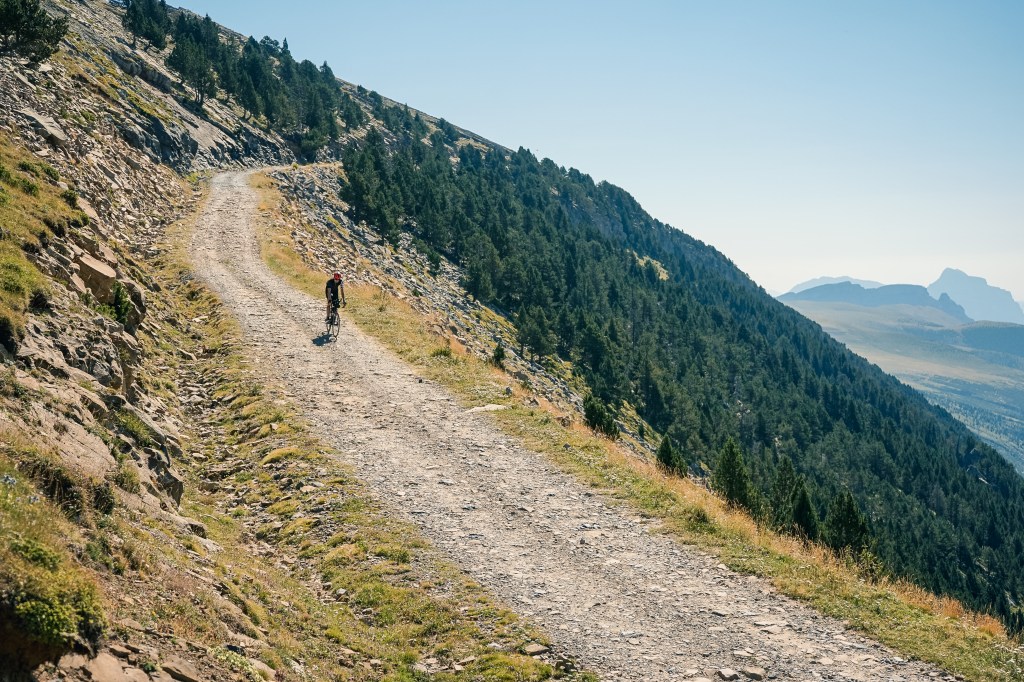
At the bottom, the last few hundred meters were quite pleasant, but of course when one problem disappears another appears. The heat and wave of 40-degree temperatures still flood almost all of central and southern Spain.
I got back onto the tarmac, welcomed by a 26% short climb that knocks me off the saddle. My whole body is too tired from this heavy gravel descend. With style, I push the bike to the top and start my further journey, trying to get back to my pace and speed from before the second checkpoint. It’s only 12:30 pm so the whole day is practically ahead of me. Just one more climb to Puerto de Cotefablo and I will be practically on a constant downhill to the next equally interesting CP, Bardenas Reales. I’m already happy like a child, but first I have to recover up after the last and quite difficult kilometres.
A few very quick, literally a few minutes’ pit-stops in roadside bars allow me to refill the water bottles with ice, refresh the whole body with ice cream and cola, refill the food for the road with more croissants and snickers, which I have already learned to drink instead of chewing because the heat was making of them chocolate-nut mousse. After descending the pass, I am again below 800 meters. As soon as I go west, a wall of wind will blow against me. Everything that I received on the first night is now taken from me on this 70 kilometre stretch along the picturesque Aragon River. There is some kind of comfort in this situation, because the wind clearly reduces the effects of heat and riding, even though a bit slower, is not that strenuous.
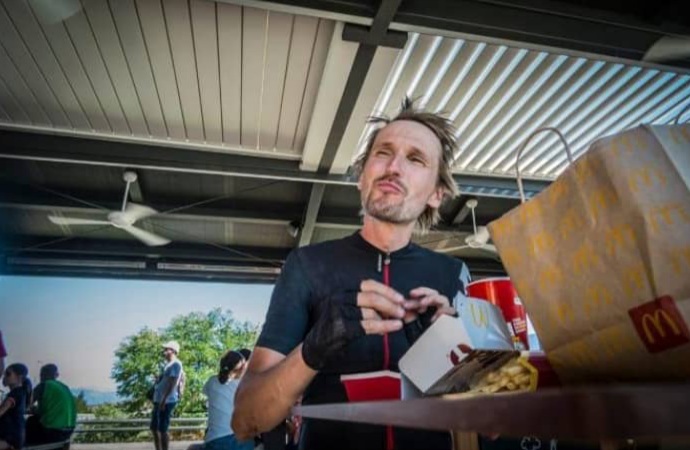
Halfway through, I stop at the long-awaited and planned way before McDonald’s. There I meet Javier who is watching the race and taking pictures of me, exchanging a few words about how crazy he is about the long distances after this year’s start in Transpyrenees. Stocked with cheeseburgers in my back jersey pockets, I move on.
Only two more small hills and a quick descent towards Sadaba, where once more I leave the tarmac road, onto a narrow asphalt-gravel road along the Bardenas canals, which are to lead me to the beginning of the obligatory section of this unique and deserted place. As the sun goes down, the temperature drops very quickly and I am already wearing my legs foil, sleeves and my Mille GT jacket.
Bardenas Reales, officially not a desert, in Spain it is called a badlands, that is, an area that is extremely hostile to an unprepared person. The gravel of this place forces me to slow down to 10-16 km per hour, so 30 km turns out to be a longer trip than an hour on the road.
Halfway up, my track turns sharply to the left. I am entering a very indistinctly visible gravel road. There are no stones, there is soil, grass, and it seems to me that there are visible traces of the disappearing but a still existing road. My Garmin is freaking out a bit, but it looks like I’m still in the vicinity of the trail. I am turning additional navigation on Ride with GPS to make sure I’m going where I should. The grass gets taller, the road practically disappears, and my trail recedes away from me. I try to walk my bike through the ever-higher dry grass to get back on track, but in front of me, there is a tall heap of natural dirt or rock. It’s hard to say because it’s totally dark. I put on my headtorch, because the dynamo light is not enough, especially when I alternately ride and push the bike over very uneven terrain trying to get back to the track that I don’t even know when I lost it. I am completely out of any road. All I can see is strange rock formations and tall grass. I stop and realize this can’t be the case and I won’t get back on track by following across this strange land. I decide to go back to the exit point from the canal and check how else I can get to the place where the mandatory parcour begins. riding a little, pushing the bike a little, I get back to the canal and I’m relieved to notice that I just turned left, three meters too early, and the hill I bumped into was a canal embankment that turned sharply left. Satisfied and a little reassured, I moved on. When I got to the parcour, the last hour of gravel started, although not the worst quality, but for 28c tires, especially after the experience in the Ordesa Park in the morning, it could have ended quite badly, so I was completely satisfied with 15km per hour.
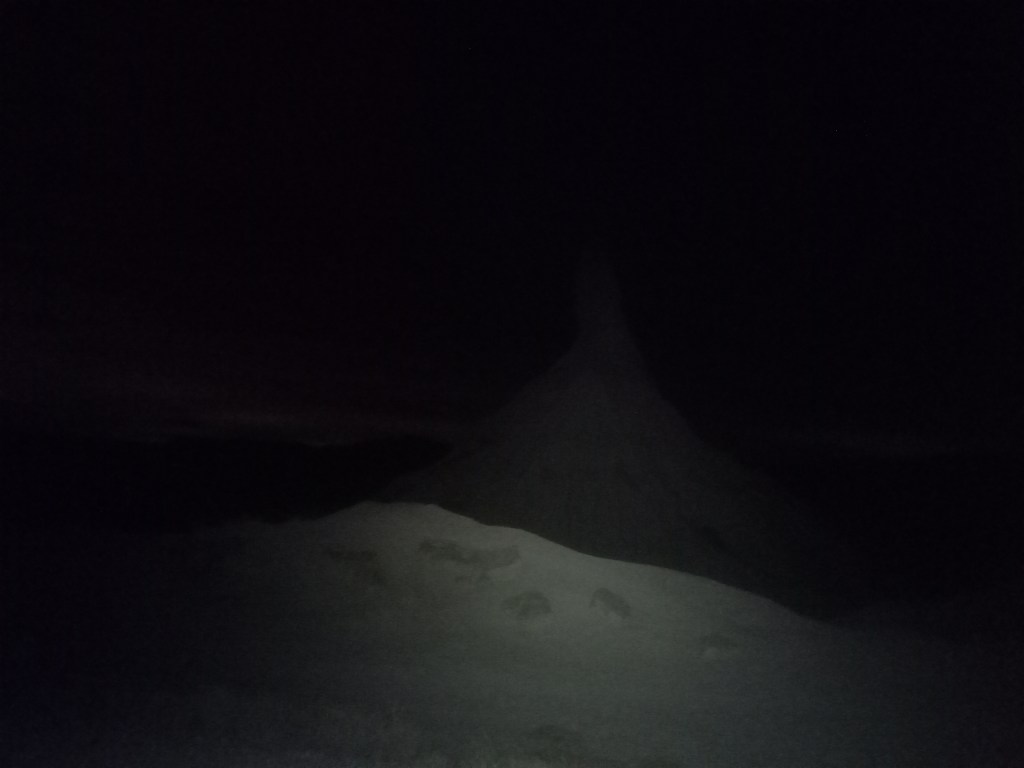
Interesting and quite iconic rock formations I can watch only in outline, illuminated by the moonlight, and in fact, I glance at them only surreptitiously, because all focus is devoted to the surface and stones lying on it, but the atmosphere of this place in the middle of the night is totally like from another planet.
Exactly at midnight, I reach the end of the parcour and this is where the race against time begins. In all other municipalities that I have on the route for the next 50 kilometres, there is a curfew, which means that from one at night till six in the morning everything will be closed. Hotels, bars, petrol stations. I will not have a chance to resupply. Without hesitating, I ride towards the nearest town, Tudela. Unfortunately, fatigue is already taking over and I am unable to reach civilization before one am. I don’t have too much food anymore and the water bottles are practically empty, so Bivi does not smile at me in such conditions. I would have to lie down until six in the morning to wait for something. I decide to ride through the night until I come across something open or a better idea will appear. Using a roadside grass sprinkler, I fill the water bottles by throwing tablets with micronutrients into them. I didn’t expect the water in the sprinklers to be warm, but it is better anyway than not having it.
After a few more quick and unsuccessful attempts to find something to eat in the Ebro Valley, I take the A121 road towards the next checkpoint. I google the stations in La Almunia de Dona. It will be open from six in the morning, so my plan clears up very quickly. It’s about 65 kilometres, I want to ride there at 4 am, sleep for two hours and get up for breakfast and coffee at 6 am. I like the plan and stand in cranks on the light but quite long climbs that I encounter along the way.
About 10 kilometres from my planned goal, I pass another petrol station. It is closed, but because the water from the sprinkler does not fully meet my expectations, I ride through the station, hoping for a tap outside. This stopover turns out to be my luck. I find the open toilet door. I go inside and I feel the warmth emanating from inside. I don’t think long, I just quickly pack my bike inside, unfold my bivi, undress practically naked and step into my silk liner. I lie down on the floor under the sink, setting the alarm clock for 6 am.
It’s four in the morning and after 475 kilometres, another two hours will have to be enough.
 Pawel Pulawski /// @pikopulawski
4 uwagi do wpisu “2. Highland and badland / Transiberica_21 / eng”